
Ahrefs vs Semrush in 2026: which one should you actually pay for?
Disclosure: Some links to SEO tools on this page are affiliate links. If you buy through them we may earn a commission, at no extra cost to you. Several of these guides tell you to buy a cheaper tool, or none at all.
Both tools cost more than most people's hosting, email and design budget combined. Both are genuinely good. And almost every comparison you will read is written by someone who gets paid when you click one of the two buttons — including, in part, this one, which is why the disclosure sits at the top rather than the bottom.
So here is the version that tries to be useful: what each one is actually better at, what the real monthly cost is once you add users and credits, and the three situations where the honest answer is neither.
The prices, side by side
Monthly billing, single user, as published at the time of writing.
| Tier | Ahrefs | Semrush |
|---|---|---|
| Entry | Starter — $29/mo | SEO — $139/mo |
| Standard small-business | Lite — $129/mo | Starter — $199/mo |
| Agency | Standard — $249/mo | Pro+ — $299/mo |
| Large | Advanced — $449/mo | Advanced — $549/mo |
| Extra users | $40–$80/mo each | From $45/mo each |
| Annual discount | Up to 17% | 17% |
| Free tier | Webmaster Tools — your own verified sites only | 1 demo project, 10 reports/day |
| Free trial | No trial on paid plans | 7 days |
Two things jump out. Ahrefs is cheaper at every comparable tier. And Ahrefs has a $29 entry plan with no real Semrush equivalent — Semrush's cheapest door is $139.
What Ahrefs is better at
Backlink data
This is the one that is not really arguable. Ahrefs built its business on a link index and it still shows: bigger crawl, fresher discovery, and a cleaner interface for working through referring domains. If your job involves link building, competitor link analysis, or working out why a rival outranks you on an identical page, Ahrefs is the tool.
Speed of use
Ahrefs does fewer things and does them with less clicking. Site Explorer answers most questions in one screen. Semrush's breadth is real, but so is the time spent finding the report you want inside it.
Price per unit of data
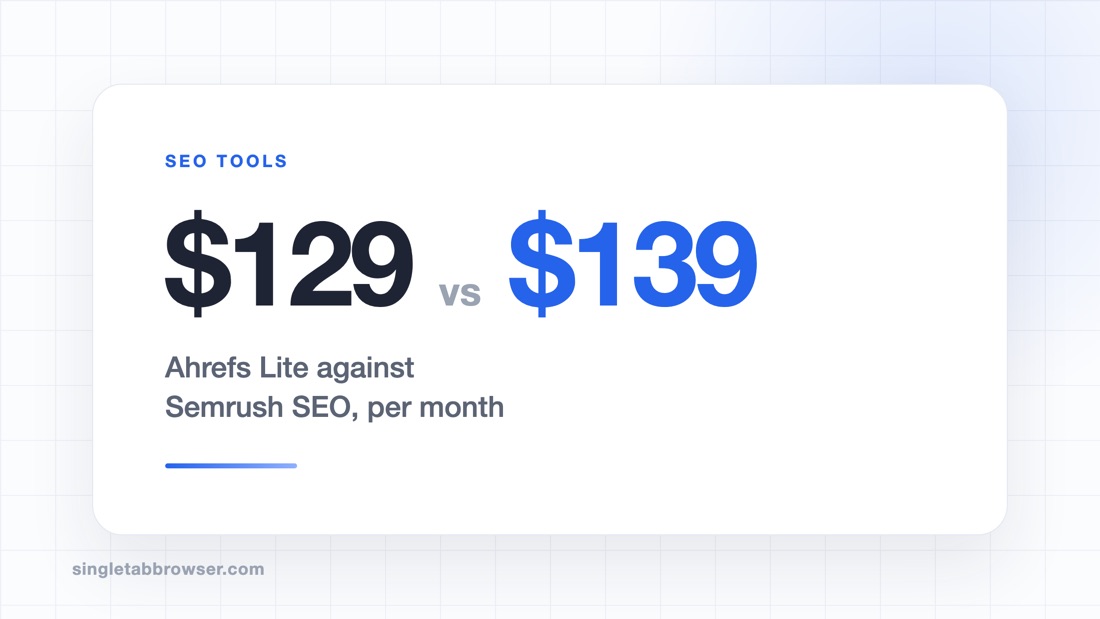
Lite at $129 gives 5 projects and 750 tracked keywords. Semrush's $139 SEO plan gives 5 websites and 500 keywords. Ahrefs gives more at a slightly lower price — before you count that Ahrefs' $29 Starter plan exists at all.
What Semrush is better at
Breadth
Semrush is not an SEO tool, it is a marketing suite that contains an SEO tool. Paid search data, display advertising, social scheduling, content optimisation, PR and listing management all sit in the same login. If you handle more than organic search, consolidating is worth real money.
Paid search intelligence
If you want to see a competitor's Google Ads copy, their estimated ad spend and the keywords they bid on, Semrush is the better tool and it is not close. Ahrefs has paid-search data; it is not the point of the product.
Keyword research for content teams
Keyword Magic Tool handles large keyword sets and intent grouping better, and the writing tools around it are built for people producing volume. If three people are publishing every week, that workflow matters.
The free trial
Seven days, properly functional. Ahrefs has no equivalent — you either buy or you use the free Webmaster Tools on your own site.
Ahrefs is a better tool. Semrush is a better suite. Which sentence matters depends on whether SEO is your whole job or one of six.
The costs the pricing page does not show
Credits on Ahrefs
Ahrefs tightened credit limits on its cheaper plans, and this is the single most common complaint about the current pricing. Crawl credits, report credits and row limits mean the $29 Starter plan is genuinely limited — fine for checking your own site, frustrating the moment you do competitive research properly. Read the per-plan limits before you assume Starter replaces Lite.
Users on both
Both charge per additional seat, and both charge a lot: $40–$80/mo on Ahrefs depending on tier, from $45/mo on Semrush. A three-person team on Ahrefs Standard is $249 + two seats, not $249.
The annual lock
17% off is real, and it is twelve months of commitment on a tool you may outgrow or stop needing. For a first subscription, pay monthly for three months, then decide.
Where this lands for an Indian business
$139 a month is roughly ₹12,300 before anything else. Add the 2–3% forex markup most Indian cards charge on international transactions, and 18% GST under reverse charge if you are registered — reclaimable as input credit, but still cash out first. A ₹12,300 sticker becomes closer to ₹15,000 leaving your account each month.
That is a real number for a small Indian agency or a solo consultant, and it changes the answer. A tool that costs ₹1.8 lakh a year has to produce ₹1.8 lakh of work you could not otherwise do. For a lot of people it does not — which is the point of the next section. The full breakdown is in what SEO tools actually cost in India.
Three cases where the answer is neither
1. You have one site and under 50 pages
Google Search Console tells you what you rank for, what gets clicked and what Google could not index. Ahrefs Webmaster Tools gives you your own backlink profile and a site audit for free. That covers most of what a small site needs — see the free stack that covers 80%.
2. You mainly need rank tracking
Paying $139 a month for a rank tracker is a bad trade. Dedicated trackers cost a fraction of it, and what you actually need to track is usually a smaller list than you think.
3. Your budget is under $50 a month
Mangools at $29.90/mo on annual billing and SE Ranking at $65/mo monthly are both real tools, not toys. Covered properly in the cheapest SEO tools that are actually good.
How to choose in one question
Ask what you did last week.
- Analysed backlinks, checked why a competitor ranks, audited a site's technical health → Ahrefs.
- Planned content, researched a competitor's ads, reported to a client across channels → Semrush.
- Looked at Search Console and wrote something → neither, yet.
If you genuinely do both halves, most agencies that can afford it run Ahrefs for link and competitor work and Semrush for content and paid, and treat the combined cost as a line item rather than a choice. If you cannot afford both, buy the one that matches the work you actually do, not the one that matches the work you intend to start doing.
How to test them properly
Do not evaluate on the demo data. Take one real question you could not answer last month — "why does this competitor outrank us for this term" — and answer it in each tool.
- Start Semrush's 7-day trial and give yourself two hours, not seven days. Trials expire while you are busy. Getting real value out of those seven days is a short, deliberate exercise.
- For Ahrefs, verify your site in the free Webmaster Tools first. It will not answer competitor questions, but it tells you whether the interface suits you — covered in Ahrefs Webmaster Tools vs Search Console.
- Write down the answer each tool gave, and how long it took. Buy the one that was faster for you, not the one with more features.
The question people should ask first
Not "which tool", but "what would I do differently if I knew the answer". A surprising amount of competitor research produces a fact and no decision — you learn a rival ranks for 4,000 terms, feel briefly worse, and change nothing.
Before either subscription, write down the last three decisions you postponed for want of data. If they are decisions like "which of these five articles do I write" or "is this keyword worth targeting", a ₹3,300-a-month tool answers them. If they are "where are their links coming from and can I get the same ones", you are in Ahrefs territory and the price is justified. If the list is empty, the honest answer is that neither tool is the constraint yet.
What neither of them does
Both are competitor-intelligence products, and both are estimates. Keyword volumes are modelled, traffic figures are modelled, and difficulty scores are each company's own opinion expressed as a number. They are useful for comparing two options; they are not measurements.
Your real data lives in Search Console, free, and neither tool replaces it. Treat the paid tool as a way to see outside your own site and the free one as the source of truth about it — people who get this the wrong way round end up optimising towards a competitor's estimated traffic while ignoring their own actual clicks.
Our verdict
For most people reading this, Ahrefs Lite at $129 is the better buy — better link data, better price per unit, less time lost to navigation. Choose Semrush if you own paid search as well as organic, or if the person using it is a content marketer rather than an SEO.
And if the honest answer is that neither is affordable yet, that is a perfectly good answer. The free stack plus a ₹2,500/month tool will not hold you back at this stage — what holds sites back is almost never the tool. If you are checking SERPs from the browser day to day, our shortlist of SEO extensions covers that layer for nothing, and the SEO extensions category has the rest.
Where to check Semrush pricing
Semrush — Four plans from $139/month, with a 7-day free trial on the paid tiers. See current pricing.
Frequently asked questions
Is Ahrefs cheaper than Semrush?
Yes, at every comparable tier. Ahrefs Lite is $129/month against Semrush's $139 SEO plan, Standard is $249 against Pro+ at $299, and Ahrefs also has a $29 Starter plan with no Semrush equivalent. Both charge extra for seats and both discount annual billing by about 17%.
Which is better for backlinks?
Ahrefs, and it is not a close call. The company built its business on a link index and it still has the bigger, fresher crawl plus a cleaner interface for working through referring domains. If link building is a service you sell, this is the deciding factor.
Does Semrush do anything Ahrefs cannot?
Paid-search intelligence. Competitor ad copy, estimated ad spend and the keywords they bid on are genuinely better in Semrush, and nothing in the cheaper tier replaces that data. Semrush is also a wider suite covering social, PR and listings in one login.
Can I use both?
Agencies that can afford it often do — Ahrefs for link and competitor work, Semrush for content and paid — and treat the combined cost as a line item rather than a choice. For everyone else, buy the one that matches the work you actually did last week.