
What SEO tools actually cost in India, after GST and forex
Disclosure: Some links to SEO tools on this page are affiliate links. If you buy through them we may earn a commission, at no extra cost to you. Several of these guides tell you to buy a cheaper tool, or none at all.
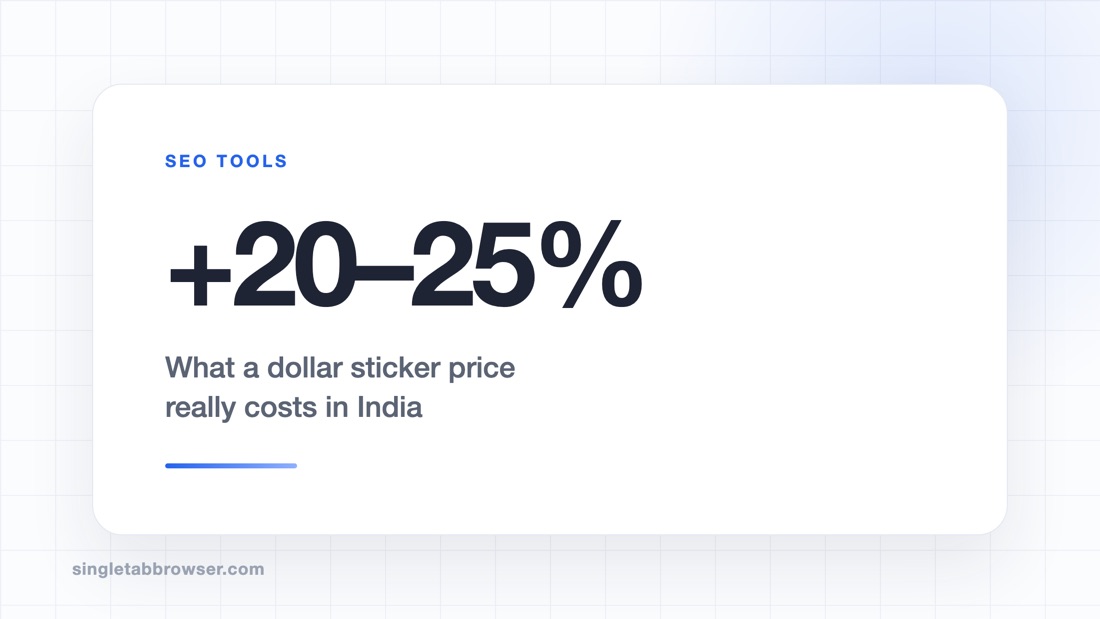
Every SEO tool worth using is priced in dollars by a company that is not in India. The sticker price is therefore never the price. Between the exchange rate, the card markup and GST, what leaves your account is reliably 20–25% above the number on the pricing page.
This is the arithmetic written out, for every tool a small Indian business actually considers, plus the two things GST-registered businesses should be doing and usually are not.
The three things added to a dollar price
1. The exchange rate
Obvious but worth stating: at roughly ₹88 to the dollar, $139 is about ₹12,200. This moves, and it has only moved one way over the last decade. A tool you commit to annually is a tool you are also taking a currency position on.
2. The forex markup on your card
Indian credit and debit cards typically add a 2–3% foreign transaction fee on international payments, and some banks add a flat cross-border charge on top. This never appears on the merchant's invoice — it appears on your statement, which is why people miss it for months.
3. GST at 18%
Software bought from a foreign supplier is taxed in India. How it reaches you depends on your status:
- GST-registered business: the supply falls under reverse charge. You self-assess 18% IGST, raise a self-invoice, report it in GSTR-3B and claim it back as input tax credit if the tool is used for business. Net cost: nothing — but it is cash out first and paperwork always.
- Not registered: the foreign supplier is generally required to collect GST from you under the OIDAR rules, and you cannot reclaim it. Net cost: a flat 18% more, permanently.
That second case is the one people underestimate. For an unregistered freelancer, every tool on this page costs 18% more than it does for a registered agency, forever.
If you are unregistered and spending more than about ₹20,000 a month on foreign software, registration pays for its own paperwork.
What each tool actually costs, in rupees
At ₹88/$ with a 2.5% card markup. The "registered" column is what it costs you after reclaiming GST; the "unregistered" column includes the 18% you cannot get back.
| Tool and plan | USD/mo | Registered ₹/mo | Unregistered ₹/mo | Unregistered ₹/yr |
|---|---|---|---|---|
| Ahrefs Starter | $29 | ≈ ₹2,620 | ≈ ₹3,090 | ≈ ₹37,100 |
| Mangools Basic (annual) | $29.90 | ≈ ₹2,700 | ≈ ₹3,190 | ≈ ₹38,200 |
| Mangools Premium (annual) | $44.90 | ≈ ₹4,050 | ≈ ₹4,780 | ≈ ₹57,400 |
| SE Ranking Essential | $65 | ≈ ₹5,870 | ≈ ₹6,920 | ≈ ₹83,100 |
| SE Ranking Pro (annual) | $95.20 | ≈ ₹8,590 | ≈ ₹10,140 | ≈ ₹1,21,700 |
| Ahrefs Lite | $129 | ≈ ₹11,640 | ≈ ₹13,740 | ≈ ₹1,64,800 |
| Semrush SEO | $139 | ≈ ₹12,540 | ≈ ₹14,800 | ≈ ₹1,77,600 |
| Ahrefs Standard | $249 | ≈ ₹22,470 | ≈ ₹26,510 | ≈ ₹3,18,100 |
| Semrush Pro+ | $299 | ≈ ₹26,980 | ≈ ₹31,840 | ≈ ₹3,82,100 |
Check today's rate before committing — these are illustrative, not quotes.
The number that should drive the decision
Not the monthly price. The annual one, against what the tool lets you earn or save.
Semrush's entry plan is about ₹1.78 lakh a year for an unregistered freelancer. For that to be a good purchase, it has to produce roughly one additional retainer client, or save you enough hours to take on one. If you cannot name the specific way it does that, the answer is no — not "not yet", just no, until the work changes.
Conversely, Mangools at about ₹38,000 a year needs to justify roughly ₹3,200 a month. One keyword decision that avoids writing the wrong article covers it. That asymmetry is why we keep steering people to the middle tier — see the cheapest SEO tools that are actually good.
Two things GST-registered businesses should do
- Put your GSTIN on the billing profile of every foreign tool. Semrush, Ahrefs, Mangools and SE Ranking all have a tax-ID field at checkout. Filling it in is what makes the invoice usable for your reverse-charge filing.
- Keep the invoices in one folder from day one. Reverse charge means your accountant needs the documents, not just the card statement. Retrieving twelve months of invoices from four different SaaS dashboards in March is a genuinely unpleasant afternoon.
Three ways Indian buyers overpay
Paying monthly out of caution, then staying for years
Monthly billing costs 17–20% more on every tool on this page. Caution for one quarter is sensible. Caution for three years has cost you a month and a half of subscription every year.
Using a card with a 3.5% markup
Markups vary by bank from about 1.5% to 3.5%. On ₹1.8 lakh a year that spread is about ₹3,600 — small, but entirely avoidable by paying from the card with the lowest foreign transaction fee.
Buying seats instead of scheduling
Extra users cost $40–$80 a month on Ahrefs and from $45 on Semrush. Two people who use a tool on different days do not need two seats. Four who live in it do. Decide honestly; the saving is ₹40,000+ a year.
What is genuinely free and genuinely good
Before any of this, three things cost nothing and are not consolation prizes:
- Google Search Console — the only source of your real query and click data. Nothing paid replaces it.
- Ahrefs Webmaster Tools — backlink profile and site audit for sites you own. Compared with Search Console in this piece.
- Bing Webmaster Tools — includes keyword data, and takes ten minutes to set up.
Our full argument for starting here is in the free stack that covers 80%.
A budget that works
| Stage | Monthly budget | Stack |
|---|---|---|
| New site, no revenue | ₹0 | Search Console + Ahrefs Webmaster Tools + Bing |
| Site earning, one owner | ≈ ₹3,200 | Add Mangools Basic (annual) |
| Freelancer, 3–6 clients | ≈ ₹11,000 | SE Ranking Essential + Mangools Premium |
| Small agency | ≈ ₹14,000 | Ahrefs Lite or SE Ranking Pro |
| Agency selling link building | ≈ ₹27,000 | Ahrefs Standard |
A one-person agency version of this, with the reasoning, is in the stack that fits ₹5,000 a month.
What about the Indian alternatives?
Reasonable question, and the honest answer is that the serious SEO datasets are all built abroad, because building a web-scale crawl is expensive and the market for it is global. There are Indian SEO services and agencies; there is no Indian Ahrefs.
What you can do locally is avoid paying in dollars for things that do not need a global index: reporting, dashboards and project tracking can live in Looker Studio and a spreadsheet for nothing. Keep the foreign subscription for the one thing it uniquely provides — competitor keyword and link data — and stop paying dollars for the wrapper around it.
That split is the single biggest lever an Indian solo operator has on this bill, and it is usually worth more than switching tools.
Paying annually when the rupee is the risk
Annual billing saves 17–20% on every tool here, and it also fixes your price in dollars for a year. For an Indian buyer that second part is doing quiet work: the rupee has drifted one way against the dollar for a long time, so locking a dollar price for twelve months has usually been the cheaper side of the trade.
The counter-argument is the one that actually matters, though. Annual billing is only cheaper if you were going to pay for all twelve months anyway. A tool abandoned in week six is not 17% cheaper, it is 100% wasted. So: monthly for the first quarter, annual after — the discount you forgo is smaller than the mistake you avoid.
Watch the renewal date, not the sign-up date
Dollar-priced subscriptions renew at whatever the exchange rate is on the day, and annual plans renew at whatever the list price has become. Both move, and neither sends a warning you will read.
Put the renewal date of every tool in a calendar with a two-week lead. That gives you time to check the current rate, confirm you still use the tool, and cancel without the awkward refund conversation. It is a five-minute habit that routinely saves an Indian freelancer a full subscription a year.
A quick way to sanity-check any subscription
Take the annual rupee cost from the table above and divide it by your average monthly retainer or margin. That gives you the number of clients the tool costs you.
Semrush at roughly ₹1.78 lakh a year, against a ₹15,000 monthly retainer, is about one client's annual revenue. Framed that way the question answers itself: would this tool win or retain one client over a year? Sometimes yes, often no, and the framing is more honest than any feature comparison.
Do the same sum for Mangools at around ₹38,000 a year and it needs to justify roughly a fifth of one client. That is a much easier bar, which is why the cheap tier is where most Indian solo operators should start — and why the upgrade should wait until a specific job demands it.
Verdict
Assume every dollar price is 20–25% higher in practice, and budget annually rather than monthly. If you are GST-registered, get your GSTIN onto every invoice so the 18% comes back. If you are not registered and your tool spend is climbing, work out whether registering is now cheaper than not.
And resist the instinct that the expensive tool is the professional choice. The Indian market rewards margin, and ₹1.4 lakh a year of saved subscription buys a lot of content — or, more usefully for most sites, a few genuinely good backlinks.
Where to check Mangools pricing
Mangools — About ₹3,300 a month on annual billing — the tier most Indian solo operators should start at. See current pricing.
Frequently asked questions
Do I pay GST on foreign SEO tools in India?
Yes. If you are GST-registered the supply falls under reverse charge: you self-assess 18% IGST, raise a self-invoice, report it in GSTR-3B and claim it back as input credit. If you are not registered, the supplier generally collects GST under the OIDAR rules and you cannot reclaim it.
How much extra do Indian cards charge?
Most Indian credit and debit cards add a 2–3% foreign transaction fee on international payments, and some banks add a flat cross-border charge. It never appears on the merchant's invoice, only on your statement, which is why people miss it for months.
What does Semrush cost in rupees?
The $139 SEO plan is roughly ₹12,200 at ₹88 to the dollar, about ₹12,500 after a typical card markup, and around ₹14,800 a month if you are not GST-registered and cannot reclaim the 18%. Budget ₹1.78 lakh a year in that case.
Should I pay annually for an SEO tool?
After a quarter of monthly use, yes — annual saves 17–20% and fixes your dollar price for a year. Before that, no: a tool abandoned in week six is not 17% cheaper, it is entirely wasted.