
An SEO stack for a one-person agency that fits ₹5,000 a month
Disclosure: Some links to SEO tools on this page are affiliate links. If you buy through them we may earn a commission, at no extra cost to you. Several of these guides tell you to buy a cheaper tool, or none at all.
The advice written for one-person agencies is almost always written by companies selling to twenty-person agencies. It assumes your tool budget is a rounding error against salaries. When you are the only salary, ₹15,000 a month of software is a client's worth of margin.
So this is a stack that fits about ₹5,000 a month, what it genuinely cannot do, and the point at which spending more starts paying for itself.
The ₹5,000 stack
| Tool | Cost | Job |
|---|---|---|
| Google Search Console | Free | Real query, click and indexing data |
| Ahrefs Webmaster Tools | Free | Site audits and own backlink profiles |
| Bing Webmaster Tools | Free | Keyword volumes, second index |
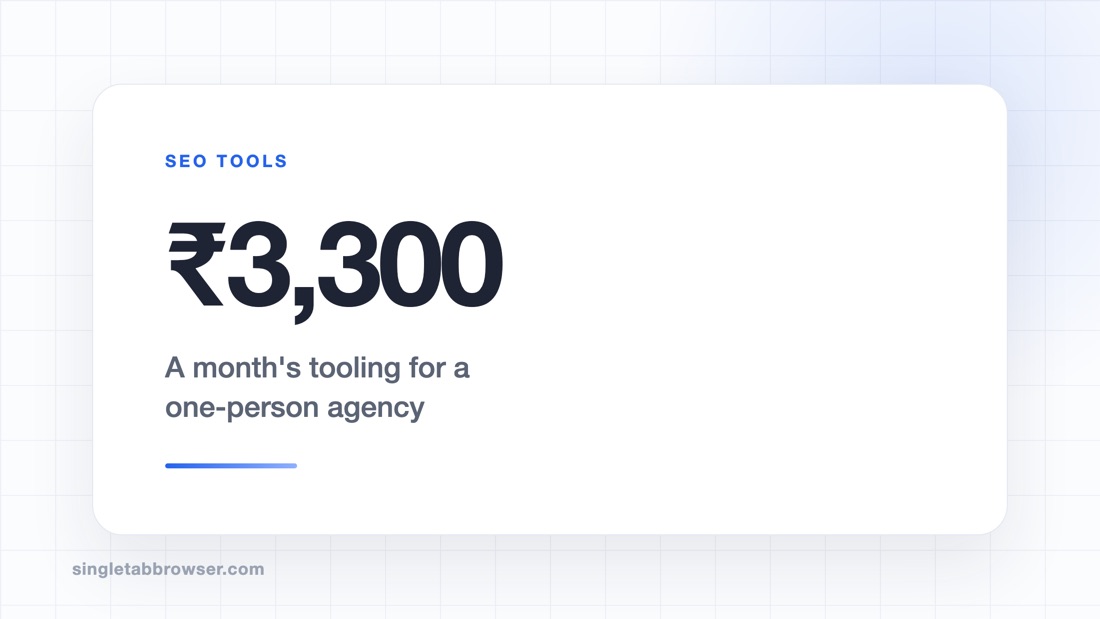
| Mangools Basic (annual) | ≈ ₹3,300/mo | Keyword research, rank tracking |
| Google Sheets / Looker Studio | Free | Client reporting |
| Total | ≈ ₹3,300/mo |
That leaves headroom inside ₹5,000 for one more thing when a specific client needs it, which is the right shape for a solo business — low fixed cost, variable spend against revenue.
Why this works
A one-person agency does three things repeatedly: find what to write, fix what is broken, and show the client that something improved. The free tools cover two of those completely.
Search Console covers reporting and diagnosis. Real queries, real clicks, real indexing problems — per client, free, forever. Every client gets their own property and you get access.
Ahrefs Webmaster Tools covers auditing. Verify each client's site and you get a genuine crawl and their backlink profile. For a solo operator running a handful of sites, this is the single most underused free tool in the industry.
The paid gap is keyword research, and Mangools fills it for about ₹3,300 on annual billing. Lookups are capped per 24 hours — 100 on Basic — which suits someone planning a client's content monthly rather than running research all day.
Your clients are not paying for your tool subscriptions. They are paying for the decisions you make with them.
What this stack cannot do
Be honest with yourself about the gaps, because they decide when to upgrade.
- Deep competitor keyword gaps. You can see what a competitor ranks for roughly; you cannot do a rigorous gap analysis across five competitors.
- Serious link prospecting. AWT shows your clients' links, not their competitors'. If you sell link building, this stack does not support the service.
- Paid-search intelligence. Competitor ad copy and spend is a Semrush feature with no cheap equivalent.
- White-labelled automated reports. You will build reports in Sheets or Looker Studio. It works, and it takes you an hour a month per client that a paid tool would not.
Three of those four only matter if you sell those services. The fourth is a real cost in your time — which is the first thing worth paying to fix.
The first upgrade: when and to what
Upgrade when a specific, repeated task is costing you more in hours than the subscription costs in rupees. For most solo operators that is client reporting, and the answer is SE Ranking.
SE Ranking Pro at $95.20/month on annual billing — about ₹8,600 — gives 3 seats and 30 projects. The seats matter less than the projects when you are one person; what you are buying is per-client rank tracking and reports that generate themselves. If you have six clients and spend an hour a month on each report, that is six hours you get back.
Essential at $65/month is the smaller version: 1 user, 5 projects, 500 tracked keywords. Fine at three or four clients. The wider comparison is in the cheapest SEO tools that are actually good.
The second upgrade: only if you sell it
Ahrefs Lite at $129/month — around ₹13,700 all-in — is the right call only when link building is a service you charge for. Not when you read about link building, not when a client once asked about backlinks. When there is a line item on an invoice.
At that point the subscription is a cost of goods, not overhead, and it should be priced into the service. A solo operator charging for link building and not budgeting the tool into the retainer is working for the tool. Pricing detail is in Ahrefs pricing explained.
Three rules that keep the bill honest
- Every tool must map to a line on an invoice. If you cannot say which service it supports, cancel it. This one rule removes most SaaS creep.
- Annual billing only after a quarter of monthly use. Annual saves 17–20%, and it is a bad trade on a tool you stop opening in week six.
- Review every subscription in April. Pick a date, put it in the calendar, open the card statement, and cancel whatever you did not open last month.
The India-specific bit
Every tool here is billed in dollars. Your card adds 2–3% on international transactions, and if you are GST-registered you self-assess 18% IGST under reverse charge — reclaimable as input credit, but paid out first. If you are not registered, the 18% generally sticks.
So: get your GSTIN onto every tool's billing profile, keep the invoices in one folder from day one, and if your foreign software spend is climbing past about ₹20,000 a month while unregistered, work out whether registering is now cheaper than not. The full arithmetic is in SEO tool costs in India.
Reporting without a reporting tool
Until you buy SE Ranking, this takes about thirty minutes per client per month:
- Looker Studio connected to Search Console. One template, duplicated per client. Clicks, impressions, top queries, top pages, month on month.
- One paragraph of commentary. What changed, what you did, what is next. Clients read this and skim the charts.
- A short list of what you actually shipped. Pages published, fixes made, links earned.
It is less slick than a branded PDF and it is frequently more convincing, because it is specific. Build the template once and the monthly cost is the commentary.
The client access you should set up on day one
Before any tool, get this right, because it is free and it is the thing that bites later.
- Search Console access, on the client's own property. Not a property you created on your own account. When the relationship ends they keep their data and you keep your reputation.
- Analytics access, same principle, with you as a user rather than the owner.
- Their domain and hosting in their name, with you holding delegated access.
Solo operators often do the opposite because it is faster to set up, and then every exit becomes a negotiation about who owns what. Doing it properly costs an extra ten minutes per client and removes an entire category of awkward conversation.
Pricing the tools into your retainer
Solo operators routinely absorb software as overhead and then wonder where the margin went. Treat it the way a builder treats materials.
If a retainer includes rank tracking and monthly reporting, the share of SE Ranking that client consumes is a cost of that service. At ₹8,600 a month across six clients, that is about ₹1,400 each — a line you can justify, and a number that stops you discounting below your own costs. The same applies to Ahrefs if you sell link building.
The test is simple: if you lost the client tomorrow, would you cancel anything? If yes, it belongs in their price. If no, it is overhead and should be as small as possible — which is the entire argument for starting at ₹3,300 rather than ₹15,000.
One subscription worth more than any SEO tool
Not an SEO tool at all: whatever you use to write and publish faster. For most solo operators the bottleneck is not knowing what to write, it is getting it written while also doing client calls.
That might be a writer, an editor, or simply a calendar discipline that protects two mornings a week. None of it shows up in a tool comparison, and all of it moves rankings more reliably than upgrading from a ₹3,300 subscription to a ₹15,000 one. Tools tell you what to do; they do not do it.
What to spend the saved money on
The gap between this stack and a full Semrush subscription is roughly ₹11,000 a month, or ₹1.3 lakh a year. Three things buy more growth than the upgrade would:
- Writing. A competent freelance writer producing two solid articles a month for a client is worth more than any dashboard.
- A few genuinely good backlinks. Earned or placed properly, not bought in bulk.
- Your own site. Solo operators neglect it, then wonder why inbound leads do not arrive. The clients you win from your own content cost you nothing per lead.
Verdict
Free stack plus Mangools, about ₹3,300 a month, is a complete setup for a one-person agency with a handful of clients. Add SE Ranking when reporting hours start hurting. Add Ahrefs when link building is on an invoice.
Resist the stack that looks professional. The clients who stay are the ones whose traffic went up, and that follows from content and links — not from which dashboard you logged into. If you are weighing the expensive tools anyway, Ahrefs vs Semrush is the comparison, and the SEO extensions shortlist covers the browser-side work for nothing.
Where to check Mangools pricing
Mangools — The one paid tool in this stack — from $29.90/month on annual billing, with a 10-day trial and no card. See current pricing.
Frequently asked questions
What SEO tools does a solo freelancer actually need?
Search Console and Ahrefs Webmaster Tools per client (both free), Bing Webmaster Tools for keyword data, one paid keyword research tool such as Mangools at about ₹3,300 a month, and Looker Studio for reporting. Total fixed cost: roughly ₹3,300.
When should a solo agency upgrade its tools?
When a repeated task costs more in hours than the subscription costs in rupees. For most solo operators that is client reporting, and the answer is SE Ranking Pro at about ₹8,600 a month for three seats and thirty projects.
Should I charge clients for my SEO tools?
Price them into the retainer rather than absorbing them as overhead. The test: if you lost the client tomorrow, would you cancel anything? If yes, it belongs in their price. If no, it is overhead and should be as small as possible.
Whose account should client Search Console be on?
The client's own property, with you added as a user — never a property you created on your own account. The same applies to analytics, the domain and hosting. It costs ten extra minutes per client and removes an entire category of awkward exit conversation.